I used to think a good handoff meant a good meeting.
Everyone joins. Sales explains the deal. Delivery asks sensible questions. Someone says, "Great, I think we have everything."
Then two days later, nobody can remember whether the customer asked for weekly reporting or just mentioned it.
The meeting was fine.
The handoff was not.

The Short Answer
A reliable sales-to-customer-success handoff is an accepted CRM record, not a meeting or a Slack message.
It should show who the customer is, why they bought, what was promised, what could go wrong, who owns the relationship now, and what happens next on a real date.
AI can collect and draft that context. A human from sales must confirm it. A human on the receiving side must accept it.
If nobody accepts ownership, the handoff has not happened.
Why Handoffs Break in Growing Teams
In an 11-50 person company, the handoff often lives in several places at once.
The commercial promise is in an email. The buyer's real concern is in meeting notes. The contract scope is in a PDF. The next call is on somebody's calendar. The awkward implementation risk was mentioned in a private message.
The CRM says "Closed won."
Technically correct. Operationally useless.
This is why the problem often appears after the sale.
Customer success or delivery asks the customer to repeat information. Sales gets pulled back into the account. An expectation appears that nobody on the delivery side knew about. The first onboarding call becomes an investigation.
None of this feels dramatic enough to become a major project.
It just creates small moments of doubt.
And small moments of doubt are expensive at the start of a customer relationship.
The Handoff Record Needs Seven Things
You do not need a 47-field form.
You need a small record that people can complete and trust.
For most teams, I would start with these seven parts.
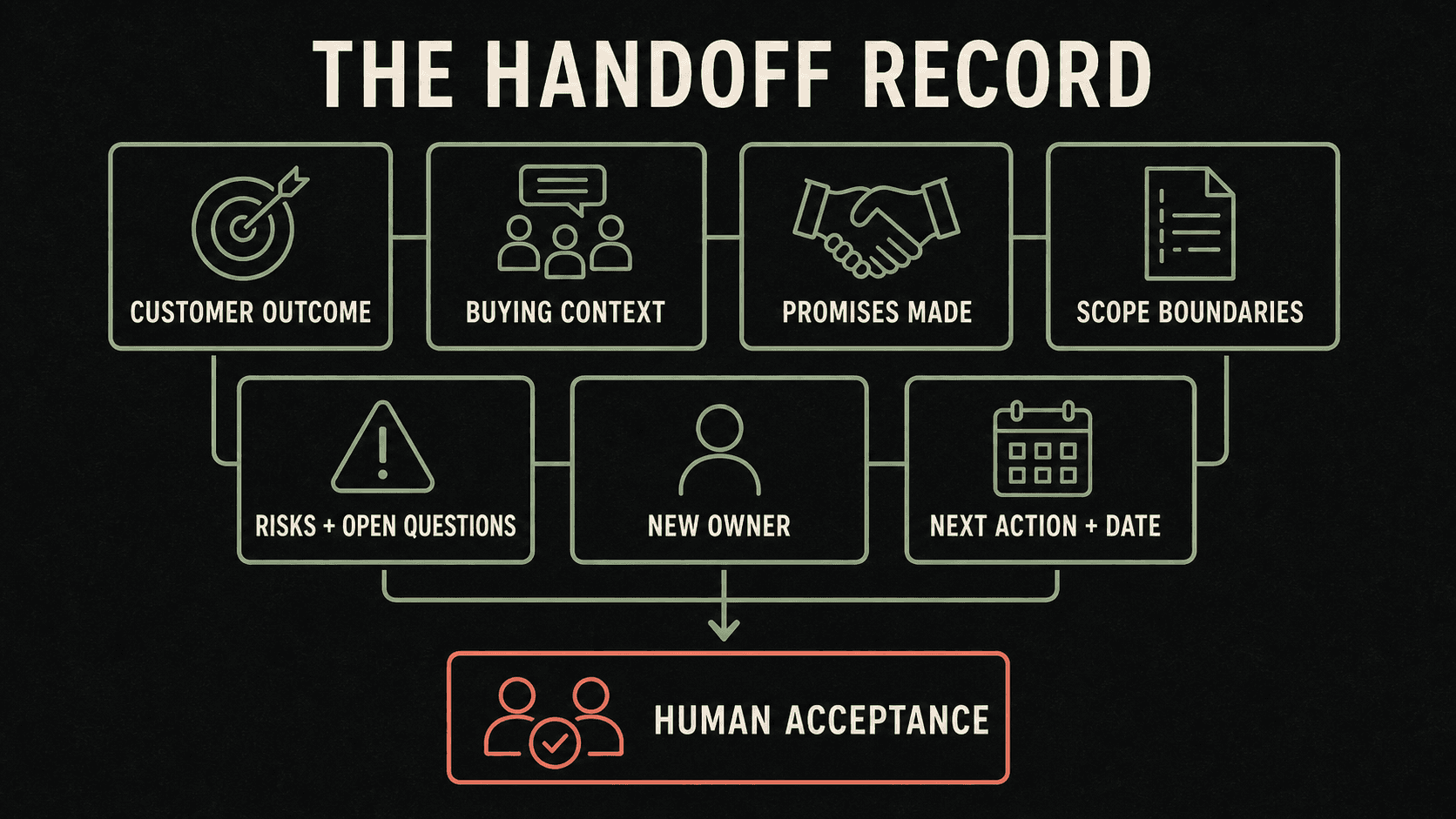
What is the customer trying to improve?
Not the product they bought. Not the package name. The operational result they expect.
"CRM implementation" is scope.
"Stop leads being lost between the website form and the first sales call" is an outcome.
Why now?
Record the trigger, the main pain, the decision process, and the people who influenced the purchase. This helps the receiving team understand what matters when priorities start competing.
Write down every commitment that could change scope, timing, reporting, access, or the customer's expectations.
This field can be slightly uncomfortable.
That is usually a sign it is useful.
What is included, and what is explicitly not included?
The contract should remain the source of truth. The CRM handoff should make the important boundaries visible without asking the new owner to hunt through documents.
What could slow the work down? Which access is missing? Is the data messy? Is a stakeholder unconvinced? Is there a deadline that depends on somebody outside the project?
A handoff that only contains good news is usually a sales summary, not an operating record.
Name one person who owns the customer relationship after the handoff.
Sales can remain involved. Several people can contribute. But one person needs to be able to answer, "This is mine now."
What happens immediately after acceptance, who does it, and by when?
"Start onboarding" is not a next action.
"Marta sends the access checklist by Tuesday at 15:00" is.
The Meeting Is a Review Step
Once the record exists, the handoff meeting becomes much more useful.
It is no longer a live performance where sales tries to remember the last six weeks.
The receiving owner can review the context before the call. The meeting can focus on gaps, risks, and decisions. After the call, that person either accepts the handoff or sends it back with specific missing items.
That acceptance matters.
Without it, both teams can assume the other one owns the next step.
I would make the process explicit:
The notification is helpful.
The acceptance is the system.
Where AI Helps, and Where It Should Stop
AI is very useful for the boring preparation work.
It can summarize discovery notes, pull agreed actions from emails, compare meeting notes with a proposal, draft the buying-context section, and flag required fields that are still empty.
That saves the seller from rebuilding the story manually after the deal closes.
But AI should not quietly finalize the handoff.
It does not know whether an offhand sentence became a real promise. It may flatten an important objection into a tidy summary. It may see a proposed timeline and treat it as agreed.
The safe split is simple:
This is human-reviewed automation doing what it is good at: reducing admin without outsourcing judgment.
A Practical CRM Workflow
In Attio, HubSpot, or Zoho, the exact property names will differ. The operating logic should not.
When a deal moves to the handoff stage, an orchestration workflow can gather notes, emails, proposal details, and meeting summaries. It drafts the handoff fields and checks whether the new owner, risks, promises, next action, and date are present.
If something is missing, the workflow creates a short review task for the seller.
Once sales confirms the record, the receiving owner gets an acceptance task. Acceptance creates the onboarding action and updates the customer record. A rejection returns the record to sales with the missing reason.
Add reminders and failure alerts around that path.
Otherwise you have simply automated the creation of another stale task.
A 30-Minute Handoff Audit
Open the last ten deals your team marked closed won.
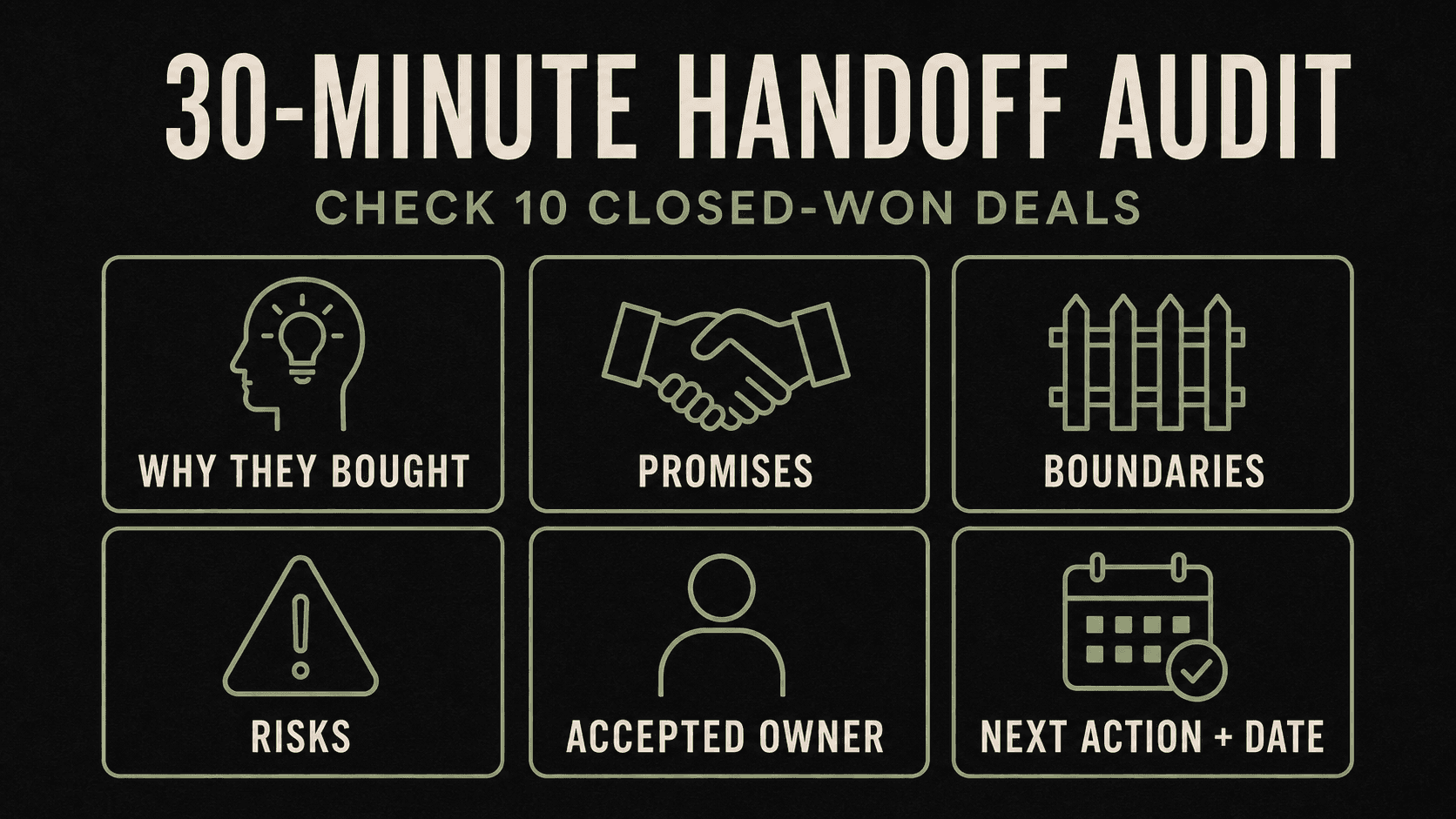
For each one, check:
You are not looking for perfect documentation.
You are looking for repeated gaps.
If seven records are missing a clear next action, fix that field and trigger first.
If promises live only in email, bring that review into the handoff.
If everybody attends the meeting but nobody accepts ownership, fix the role design.
One repeated leak is enough for the first improvement.
What This Means for Your Team
A good sales-to-customer-success handoff should make the customer feel remembered.
That does not require a larger meeting, a longer form, or an AI agent with a job title.
It requires a reliable record, a named owner, a clear review loop, and a real next action.
Start with the last ten closed-won deals.
Find the context your receiving team had to chase.
Then make that context part of the system.
If you want a second pair of eyes, Promptfields can inspect your CRM handoff, ownership rules, and follow-up workflow with you.
Practical first.
Automation second.
Adoption all the way through.