I used to think missed follow-ups were a discipline problem.
Someone forgot to reply. Someone did not create the task. Someone promised to send a recap and then got pulled into five other things.
That happens, of course. People are busy. Sales work is noisy.
But in most small teams, the real problem is not that people are careless. The problem is that follow-up lives in too many places: inboxes, meeting notes, memory, Slack threads, CRM tasks, calendar reminders, and the occasional sticky note that looked very strategic on Monday.
A CRM follow-up system fixes this by making every next step visible, assigned, timed, and reviewable. The CRM should hold the source of truth. Automation should draft and remind. Humans should still decide what gets sent, when a deal changes stage, and how to handle context.
That is the simple version.
The messy version is where most teams actually live.

The Problem Is Usually Not "No CRM"
Most 11-50 person teams already have a CRM.
Maybe it is HubSpot. Maybe Attio. Maybe Zoho. Maybe something inherited from a previous sales hire who left behind 47 properties and one view named "New pipeline final FINAL".
The issue is not always absence.
The issue is that the CRM does not tell the team what to do next.
A lead comes in. Someone replies quickly. Good start.
A call happens. Notes get written somewhere. Maybe.
A proposal goes out. Everyone feels momentum.
Then the prospect says, "Let me discuss internally."
And now the whole system depends on one person remembering to follow up at the right time, with the right context, in the right tone.
That is not a system. That is optimism with a login.
What Follow-Up Leakage Looks Like
Follow-up leakage rarely announces itself.
It looks normal from the outside.
Pipeline exists. Deals have stages. Activities are logged. Dashboards show numbers. Nobody is panicking.
But when you inspect the records, you find little gaps everywhere:
One gap is annoying.
Thirty gaps are revenue fog.
The team starts asking questions the CRM should already answer.
Who owns this?
What did we promise?
When are we following up?
Did they reply?
Is this deal real, or are we emotionally attached to it because it once looked promising?
That last one hurts a bit. Usually because it is true.
Why Small Teams Feel This More
In a large company, bad follow-up is still expensive. But there are often layers around it: RevOps, sales managers, enablement, reporting, QA, weekly pipeline calls.
In an 11-50 person team, the system is much thinner.
The founder may still sell. The first sales hire may also handle onboarding. The operations person may be responsible for CRM, reporting, contracts, customer handoff, and somehow the coffee machine.
So when follow-up depends on manual discipline, the whole system becomes fragile.
Not because the team is bad.
Because the team has too many context switches and too few operating rails.
This is where CRM and automation can help, but only if the setup is boring enough to survive real work.
The Follow-Up System I'd Build First
Before touching AI, I would fix the follow-up model inside the CRM.
Every active opportunity should have four things:
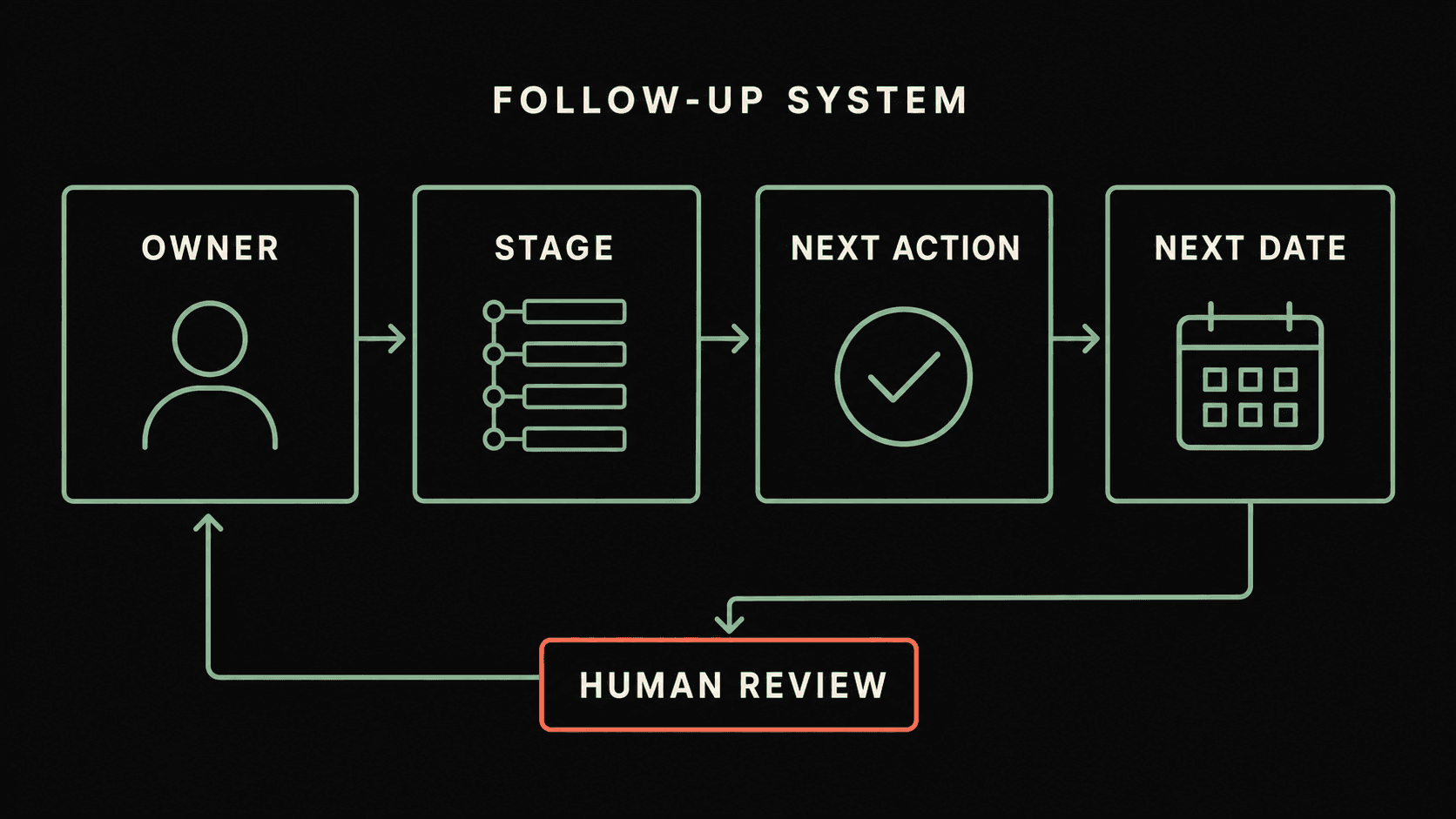
If one of those is missing, the deal is not "in progress". It is floating.
Then I would add simple rules.
When a meeting ends, create a follow-up task.
When a proposal is sent, create a check-in task for a defined number of days later.
When a deal sits in the same stage too long, flag it.
When a contact replies, pause any automated sequence and notify the owner.
When a deal moves from sales to delivery, copy the buyer context into the handoff notes.
None of this is glamorous.
That is partly why it works.
The goal is not to build an impressive automation map. The goal is to make the next right action hard to miss.
Where AI Actually Helps
AI is useful in follow-up when it has context.
It can draft the recap after a call.
It can summarize the last interaction.
It can suggest the next email based on deal stage, objections, and promised actions.
It can turn messy notes into clean CRM fields.
It can highlight missing data before a pipeline review.
But AI should not be the owner of judgment.
For most small teams, the best pattern is:
AI drafts. The CRM stores. The human reviews. Automation reminds.
That gives you speed without letting the system pretend it understands a relationship better than the person managing it.
A good follow-up draft might pull from:
A bad follow-up draft pulls from a first name and a dream.
We have all seen those emails. They are technically personalized in the same way a hotel keycard is a personal relationship.
Handoffs Are Follow-Up Too
A lot of teams think follow-up only means "email the prospect".
It also means internal follow-through.
Sales to onboarding.
Founder to account manager.
Marketing lead to sales owner.
Partner intro to first call.
Support issue to expansion opportunity.
Every handoff is a follow-up risk because context gets compressed.
"Can you take this one?" is not a handoff.
A useful handoff says:
If your CRM does not make that easy, people will avoid writing it. Not out of laziness. Out of friction.
So the design question becomes simple:
What is the minimum handoff note someone will actually complete?
Build that. Then automate around it.
A Practical 30-Minute Audit
If you want to find follow-up leakage quickly, do not start with a big workshop.
Open your CRM and inspect ten active deals.
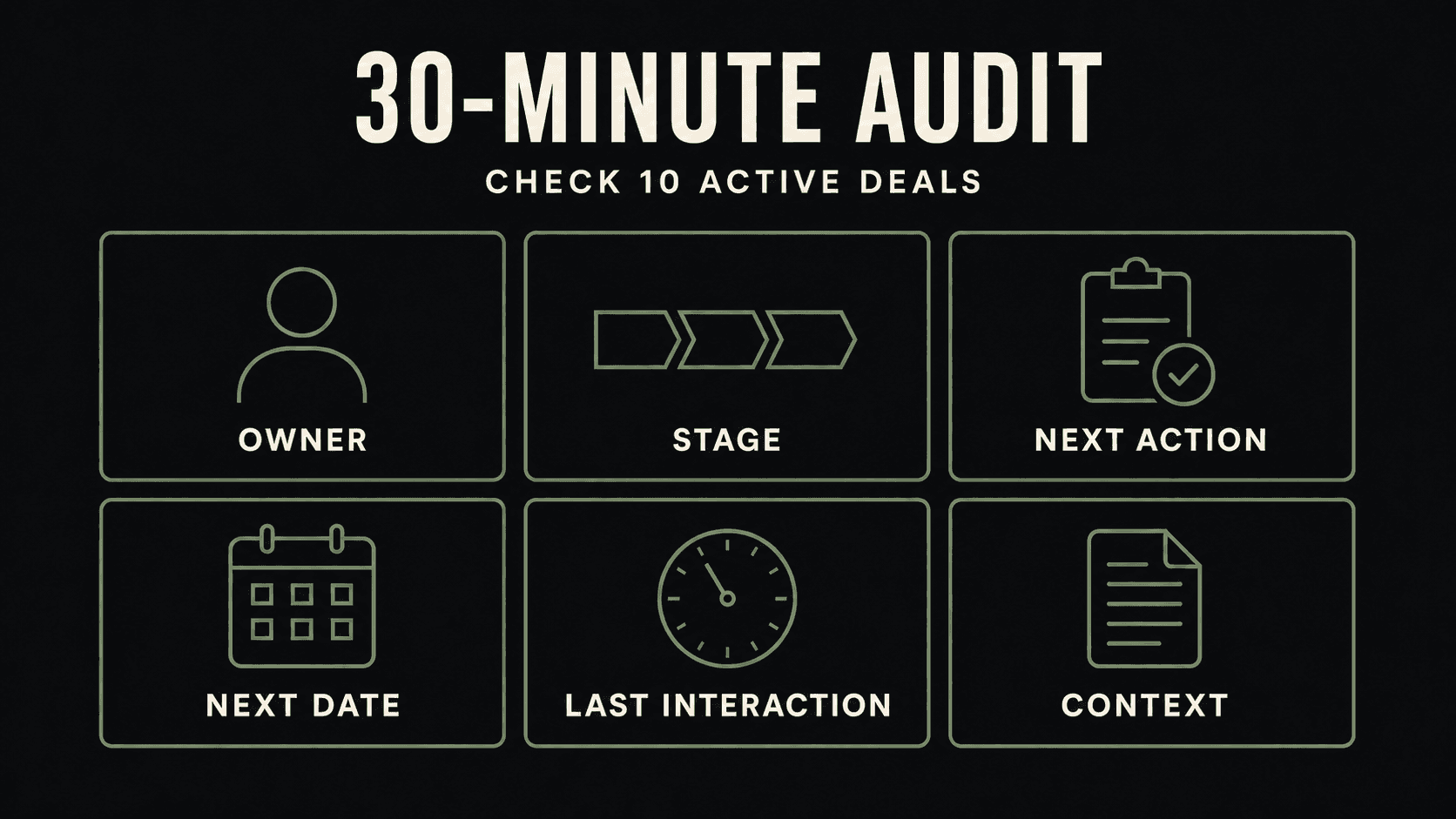
For each deal, ask:
You will usually see the pattern fast.
The issue may be data quality. Or unclear stages. Or no task rules. Or too many automations with no human review. Or a handoff process that exists in theory but not in daily work.
That is useful.
Because once you can name the leak, you can fix it.
What This Means for Your CRM
Your CRM should not be a place where sales activity goes after the fact.
It should be the operating layer for the next action.
That means the system needs to answer practical questions without a meeting:
That last question matters more in 2026 than it used to.
AI can make follow-up faster. It can also make weak CRM data louder.
If the record is messy, the automation will either produce generic output or confidently use the wrong context. Neither helps adoption.
People stop trusting the system. Then they work around it. Then the CRM becomes a reporting tax again.
Very elegant. Very expensive. Very avoidable.
Start Smaller Than You Want To
The temptation is to automate the entire follow-up process at once.
Inbound leads. Outbound sequences. Proposal reminders. Meeting recaps. Lost-deal reactivation. Customer handoff. Forecast nudges.
All useful.
Not all first.
Start with one leakage point.
For many teams, I would start with post-meeting follow-up:
That one workflow teaches you almost everything: data quality, ownership, tone, review loops, CRM structure, and whether the team will actually use the process.
Once it works, extend it.
Do not scale a workflow nobody trusts.
The Real Goal
The goal is not perfect follow-up.
Perfect is too heavy.
The goal is fewer silent deals. Cleaner ownership. Better handoffs. Less guessing. More moments where the CRM quietly tells the team what needs to happen next.
That is what adoption looks like.
Not a dashboard people admire once.
A system they use on a Thursday afternoon when they are tired and busy and still need to move the pipeline forward.
If you want to inspect your own follow-up system, start with ten deals and the questions above. You will learn more from that than from another CRM feature comparison.
And if you want a second pair of eyes, Promptfields can review your CRM, follow-up process, and automation stack with you.
No grand transformation speech required.
Just the leaks, the fixes, and the next practical step.